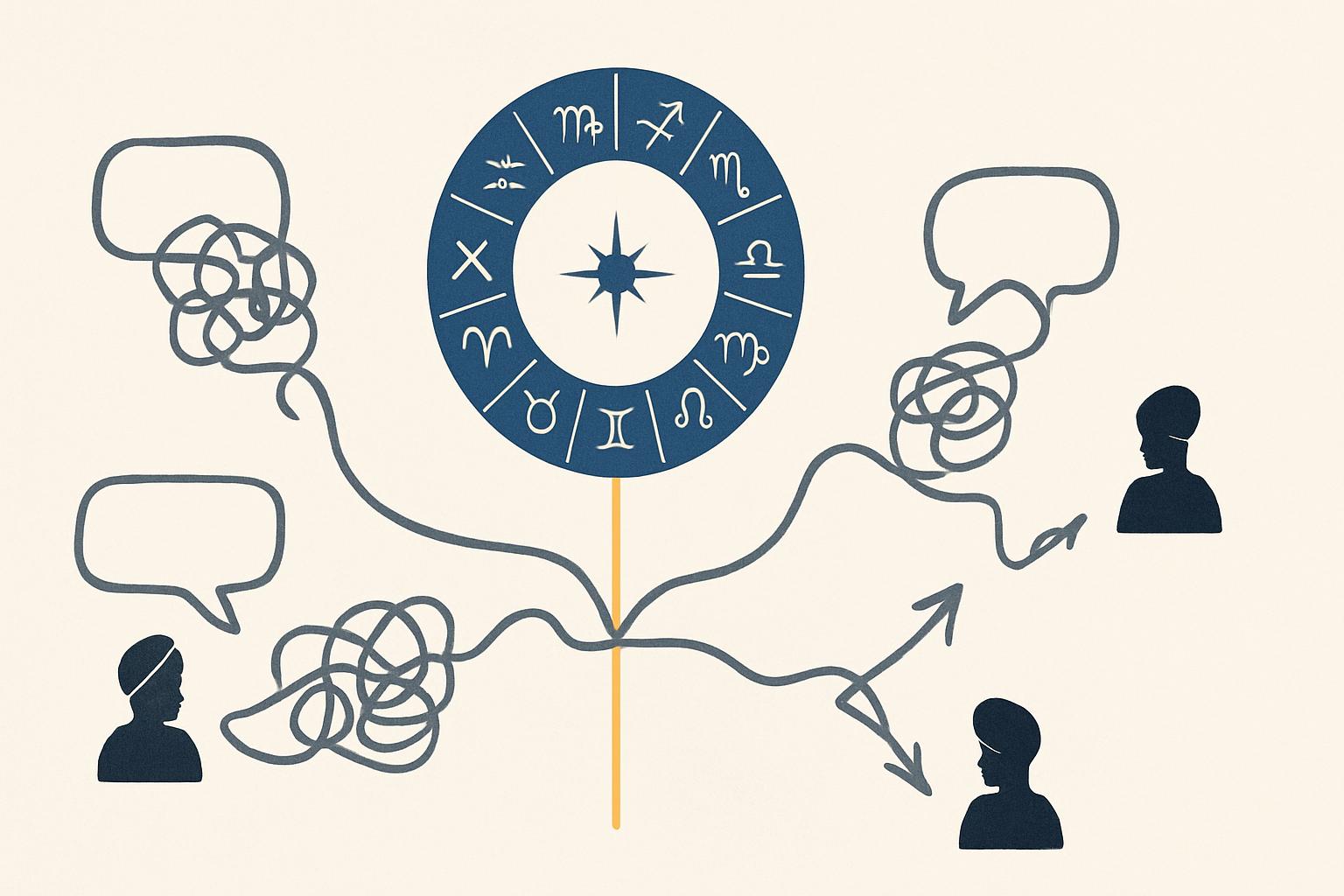
You asked three different astrologers the same question about your career switch. One said the stars favor a jump in November. Another warned you to wait until after Diwali next year. The third asked for your birth time again, then said "difficult period, please share your problem in detail." You paid for all three, and now you are more confused than when you started. This is astrologer shopping, and it is quietly draining your wallet and your peace of mind.
TL;DR: The problem is not the astrologers. It is the process. Consulting multiple humans means weighing multiple interpretations of the same chart, and that creates contradictions. A single instant kundli reading takes the same birth data and delivers one consistent, reasoned answer, which is faster and free from the bias of whoever picks up the chat.
- Astrologer shopping happens because chat apps route you to whichever expert is online, not the best fit for your chart.
- Contradictory advice is a feature of human consultation, not a flaw in Vedic astrology itself.
- An instant kundli output uses fixed computational logic on your exact birth data, so the planetary positions are never open to opinion.
- You save both time and money by getting one clear answer instead of paying for several second opinions.
Why You Keep Bouncing Between Experts
Open any major consultation app like AstroSage or GaneshaSpeaks and you will see a wall of expert profiles. Each one lists years of experience, specializations, and customer ratings. The profiles look distinct, but the service model is identical. You pay per minute or per question, and the platform assigns you to whoever is free.
Here is what actually happens when you ask, say, "Will I get married this year?" on a typical Tuesday. Platform X has 12 astrologers online. The first available one has a specialisation in "love and relationships." You chat for 15 minutes, get a general reading of your current Venus transit, and receive a remedy to chant. The answer feels incomplete, so you try another expert later that week. That person starts by asking for your full birth details, which you already provided to the first astrologer, and then reads your seventh house instead of your Venus transit. Both are legitimate Vedic techniques. They just give different answers.
This pattern is so common that it has a name in user behaviour research: choice overload. When you have too many options, you become less satisfied with the one you pick, so you keep shopping. The apps do not discourage this, because every new chat is a new transaction.
| Source of conflict | What the app shows you | Why it contradicts |
|---|---|---|
| The "generic transit" reader | Focuses on current planetary transits (e.g., Saturn in Pisces) | Transits are collective. They affect millions of people at once, so the advice stays vague to stay safe. |
| The "house placement" reader | Focuses on your natal chart house positions (e.g., Saturn in your 10th house) | This is deeply personal, but every astrologer weighs house significations differently. One may see a 10th house Saturn as a promotion, another as a job loss. |
Neither astrologer is wrong. They are just working from different layers of the same chart, and no chat platform gives you a unified report that merges those layers. So you are left to do the merging yourself, which is like asking two doctors to diagnose you over the phone without ever seeing your lab reports.
The Hidden Cost of Second Opinions
Let us put actual numbers to this behaviour, based on standard rates across the platforms named above. Astroyogi, InstaAstro, and AstroTalk generally price consultations between ₹50 and ₹300 per minute, depending on the astrologer's rating and seniority. A typical first consultation lasts 10 to 20 minutes. A follow-up inquiry for a "second opinion" runs another 10 minutes.
Here is what a single decision, like "should I accept the transfer to Bangalore?", actually costs when you shop around:
| Step | Minutes used | Rate per minute | Cost |
|---|---|---|---|
| Consultation 1 (general reading) | 15 | ₹100 | ₹1,500 |
| Consultation 2 (different expert, re-asks birth details) | 12 | ₹150 | ₹1,800 |
| Consultation 3 (specialist in career, asks for a "donation" for remedy) | 10 | ₹200 | ₹2,000 |
| Total spent on one question | 37 | - | ₹5,300 |
And the clock does not stop at the money. The average response time on a chat app is not instant. You wait for the astrologer to finish their current session. You wait for them to type. You wait for them to ask clarifying questions that you already answered in the previous chat. According to user reviews commonly posted on these platforms, the average wait between messages ranges from 2 to 5 minutes. That means your "15 minute" consultation often stretches to 40 real minutes of elapsed time.
You are not paying for insight alone. You are paying for waiting, for repetition, and for the platform's coordination overhead.
An instant kundli reading, by contrast, costs a fixed amount and returns results in seconds. The computation uses the same sidereal zodiac and the same lunar mansion (nakshatra) system as a human astrologer, but it runs on your exact date, time, and place of birth. There is no "waiting for the expert to be free" because there is no expert in the queue.
The Evidence Problem with Human Memory
Consultation apps have another hidden flaw that no one talks about: they depend on the astrologer manually entering your birth data. Look at the expert profiles on Astroyogi as an example. Each profile, like those of the experts listed under their directory, promotes years of experience and specific skills, but the data entry is still human. A single typo in your birth time shifts the ascendant (lagna) by roughly one sign every two hours, and it shifts the moon's nakshatra if the time is off by more than a few minutes.
When you repeat your birth details to a second astrologer, you are relying on them to type it correctly again. If you say "8:15 AM" but they log "8:51 AM" because the keyboard lagged, you get a reading for a different person. The astrologer has no way to verify the data because they do not run a full chart in front of you during the chat. They make mental calculations or refer to a pre-prepared table, and they trust that the platform captured the right numbers.
Instant software removes this entirely. The input is a form. You type your details once, the system validates the date format, and the output is based on an algorithmic calculation of planetary longitude. The math is transparent: the same input always produces the same chart, to the exact degree and minute. There is no "it depends on the astrologer's interpretation of your birth time" variable.
How to Get One Coherent Answer
Switching from astrologer shopping to a kundli-first approach requires a small shift in how you frame your question. You are not giving up on Vedic astrology. You are upgrading to a process that gives you a stable foundation before any human interpretation happens.
Here is a practical sequence that works:
- Get your exact birth details. Confirm the time from your birth certificate or hospital record, not from memory. A 10 minute error in the birth time can change your ascendant and invalidate the entire reading.
- Run an instant kundli. Enter that data into a computational tool and look at your current dashas (planetary periods) and major transits. This gives you the objective "what is running" statement that every astrologer should start from.
- Read your instant report for patterns. Your career questions relate to the 10th house and its lord. Your love questions relate to the 7th house and Venus. A computational report shows you these placements in one view, without the conversational detours.
- Only then approach a human expert. If you still want a consultation after reading your kundli, take the printed or digital chart to the astrologer. Ask them to explain why they are deviating from the computational summary. A good astrologer will respect the data. A confused one will dodge it, and that is your signal to walk away.
| Metric | Instant Kundli Reading | Live Chat Consultation |
|---|---|---|
| Time to first insight | Under 60 seconds | 5 to 15 minutes (queue + typing) |
| Data accuracy | Fixed algorithm, no typos | Depends on the expert's manual entry |
| Consistency across sessions | Identical chart every time | Varies with which expert is online |
| Cost for one question | Fixed flat fee | ₹50 to ₹300 per minute, open-ended |
| Bias potential | None, the chart is computed | Expert may push remedies or paid rituals |
Comments
Post a Comment